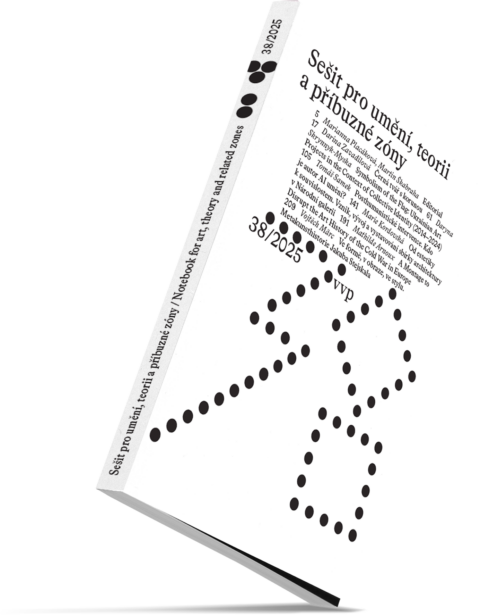
The 38th Notebook for Art, Theory and Related Zones offers readers four scholarly articles and two reviews related to contemporary practice and recent history in artistic production. In the first article of the issue, Darina Zavadilová examines the historical, social, and political dynamics along the Prague–Havana–Paris axis through a case study of an exhibition of Cuban Artist Tony Évora at Prague‘s House of Cuban Culture in 1965. Daryna Skrynnyk-Myska brings us closer to the present day, analyzing how the Russian invasion of Ukraine has changed the treatment of the flag as an object and symbol in Ukrainian art projects; the author shows that art in such a situation demonstrates an extraordinary ability to reflect different positions and perspectives. Another study is more theoretical in nature, with curator Tomáš Samek turning his attention to the question of who is the author of AI-generated art; his main starting point is the post-humanist concept of assemblage. In the last study, Marie Kordovská examines the development of the Architecture Collection at the National Gallery in Prague and the ways in which it has been presented to the public over the 35 years of its existence at the exhibitions Introducing the Architecture Collection (1993), Dream and Reality (2016), and in the permanent exhibition Architecture for All 1956–1989 (2022). In the review section, Mathilde Arnoux first discusses Marie Klimešová and Hana Rousová's book Tak blízko, tak daleko. České umění 1947–1960 v mezinárodních sociokulturních souvislostech / So Near, so Far 1947–1960. Czech Art in International Sociocultural Contexts (Prague: Arbor vitae societas 2023), which, according to the author, is exceptional in its focus on the interconnected relationships between European art scenes. The last text in this issue is Vojtěch Märce's review of Jakub Stejskal's book Metakunsthistorie (A Metahistory of Art), which reevaluates established art history concepts such as culture, style, form, image, medium, context, and material from a philosophical and aesthetic perspective.
Content
Darina Zavadilová
Black Face with a Crown. The Free Artistic Work of Cuban Graphic Designer Tony Évora
The case study examines the only surviving work from the 1965 exhibition of young Cuban graphic designer Tony Évora at the House of Cuban Culture in Prague, marking the end of Évora’s three-year study stay in Czechoslovakia. The expressive portrait of a man-child with distinctly African features and a crown on his head stands in stark contrast to Évora’s graphic works of the time, and the exhibition catalog text deviates from the more expected rhetoric of the period’s propaganda. By interpreting and contextualizing the circumstances surrounding the creation of this work, the study unfolds Évora’s Afro-Cuban identity and the complexities of artistic freedom in 1960s Cuba. The research also explores the lesser-known cultural exchanges between Czechoslovakia and Cuba, focusing on the historical, social, and political dynamics within the Prague – Havana – Paris triangle (and by extension, New York). Situating Évora’s work within the broader context of global decolonization and racial struggles, the study establishes connections with the works of other 20th-century artists, such as Wifredo Lam, among others, contributing to current discussions on the significance of perspectives from the Global South in shaping 20th-century global conflicts and cultural narratives.
Daryna Skrynnyk-Myska
Symbolism of the Flag: Ukrainian Art Projects in the Context of Collective Identity (2014–2024)
The article analyzes how the idea of collective identity, mobilized by the outbreak of the Russian-Ukrainian war in 2014 and Russia’s fullscale invasion in 2022, is contextualized in artistic projects by contemporary Ukrainian artists of different generations: Alina Yakubenko, Olia Fedorova, Illia Turyhin and Volodymyr Kaufman. Since identity is represented through national symbols, in particular, the flag, the article focuses on the works of Ukrainian artists in which the flag acquires connotations associated with the nation-state and an emotional connection to a specific place. The choice of art projects is determined by the research framework – the flag as the nominal plot and the connection with national identity, the state and the homeland as its exhibitor. The analysis of the proposed cases reveals various aspects of identity construction, including identity as an imaginary community (Benedict Anderson), the discursive nature of identity as construction through difference (Stuart Hall), the connection of identity with moral choice and responsibility for it (Zygmunt Bauman, Leonidas Donskis), and the crisis of identity as a crisis of indecision (Erik H. Erikson, Vincent Descombes). The analysis of the projects under consideration reveals the peculiarities of understanding the questions “who am I?” and “who are we?” by artistic means on the example of particular projects, as well as how art can interact with these questions at the intersection of different philosophical, anthropological and political perspectives.
Tomáš Samek*
Post-Humanistic Interventions: Who Is the Author of AI Art?
This text examines the impact of critical posthumanism on contemporary perceptions of art, particularly in the context of artificial intelligence (AI) as a creative collaborator. It challenges traditional humanist notions of the artist as an autonomous genius and questions authorship in the realm of AI-generated art. By focusing on complex networks of relationships between humans, technologies, and non-human actors (the more-than-human world), the text explores how these interactions influence artistic production. It also examines the institutional reception of AI art and how technological innovation reshapes our understanding of art itself. The article argues that AI-generated artworks complicate traditional humanist frameworks of authorship by emphasizing collective creativity and non-human agency. Drawing on post-humanist theories, the text proposes a model of “creative assemblages,” in which AI is a part of a broader network of human and non-human contributors. Through this lens, the article addresses both theoretical and institutional challenges, questioning how the art world integrates and represents AI as a creative force.
Marie Kordovská
From Aesthetics to Context: The Creation, Evolution and Exhibition Strategies of the Architecture Collection at the National Gallery in Prague
The paper explores the creation of the Architecture Collection at the National Gallery in Prague and the evolution of curatorial approaches in the exhibition of works from the collection. The primary focus is on three major exhibitions: Introducing the Collection of Architecture (1993), Dreams and Reality: 30 Years of the Architecture Collection at the National Gallery in Prague (2016), and Architecture for All 1956–1989 (2022). The paper highlights if and how curatorial strategies in mentioned architecture exhibitions have developed over the past three decades. The two former exhibitions, curated by Radomíra Sedláková, then the head of the collection, focused on the justification of the collection itself through the aesthetic and technical qualities of architectural works, often without broader social or political context. In contrast, the more recent exhibition Architecture for all 1956–1989, curated by Helena Huber-Doudová, the current director of the architectural collection, reflects a contemporary trend towards embedding architecture within a wider societal, ecological or technological discourse. This shift from the chronological sorting of the collection items to a more contextual reading of the collection within a broader understanding of architecture reflects global trends in museum exhibitions.
Mathilde Arnoux
A Montage to Disrupt the Art History of the Cold War in Europe
Review of the publication: Marie Klimešová – Hana Rousová (eds.), So Near, So Far 1947–1960. Czech Art in International Sociocultural Contexts, Prague: Arbor vitae societas 2023
Vojtěch Märc
Form, Image, Style. Jakub Stejskal‘s Metahistory of Art
Review of the publication: Jakub Stejskal, Metakunsthistorie, Praha: Display 2024