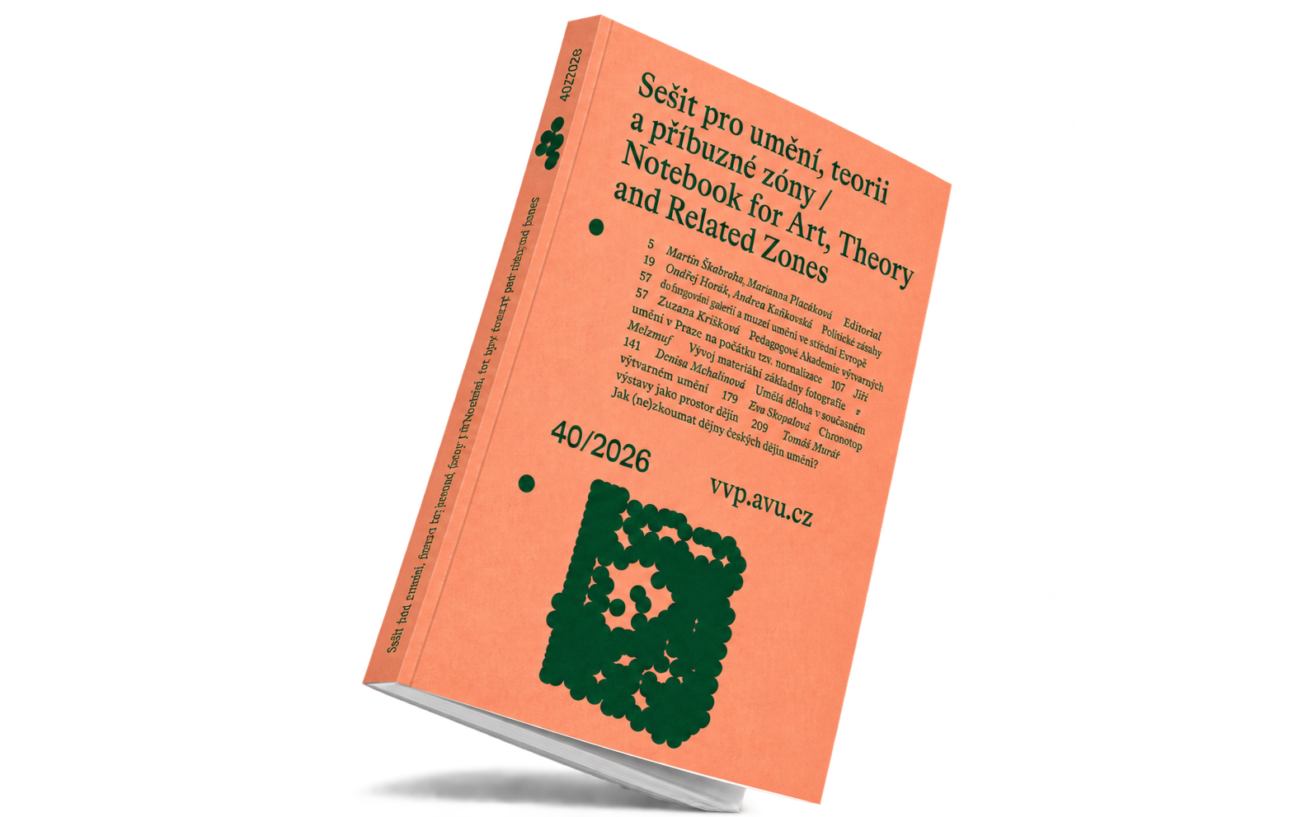
Notebook for Art, Theory and Related Zones 40/2026 presents five thematically diverse studies and one review. In the first study, titled “Political Interventions in the Operation of Art Galleries and Museums in Central Europe,” Ondřej Horák and Andrea Kaňkovská examine the influence of conservative governments on cultural institutions in Poland, Hungary and Slovakia, specifically on changes in their staffing and programming between 2010 and 2025. “Lessons drawn from the cases of the other V4 countries do not lead to a simple conclusion about the need to protect culture from political interference, but rather to the understanding that the cultural field is constantly shaped by power relations that cannot be completely eliminated—only made more transparent, slowed down and distributed in such a way that possible regime changes do not disrupt basic institutional, above all personnel, continuity,” the authors summarize at the end of their contribution. The following article by Zuzana Krišková is more historical, yet it is still not far removed from the preceding study in time or subject matter. Specifically, it focuses on the normalization period at Prague’s Academy of Fine Arts, examining various kinds of power relations that, at the institutional level, influenced personnel policy in the art world. Why did the post-August purges have a relatively limited impact at the Academy, compared with other art higher education institutions in Czechoslovakia, and why did the Academy therefore retain considerable personnel continuity? Jiří Melzmuf returns readers to the heated present. In an article on the the transformation of the relation between image information and its medium, he works with a classic Marxist conceptual framework in order to reveal the structural connections behind the seemingly effortless overproduction of visual content with which we are inundated on social networks and digital platforms. According to the author, the apparent immateriality of photography primarily serves to conceal the drastic exploitation of natural resources as well as human labor, making it invisible and more difficult to challenge. In our society, however, it is not only the reproduction of visual content that is technologically mediated, but also reproduction in a far more intimate sense: the biological continuation of the human species itself. In her text, Denisa Michalinová addresses contemporary artistic projects that in various ways thematize ectogenesis, that is, fetal development outside the body. Through specific examples (the installation UNBORN0X9 and works by the Keiken collective), she traces both the history of and current thinking about this technology, which could serve as an emancipatory tool, or, conversely, as a tool that intensifies traditional inequalities among various disadvantaged groups. The final study in the issue was written by Eva Skopalová. Inspired above all by Paul Ricoeur and M. M. Bakhtin, she uses the concept of the chronotope to consider the exhibition as a spatial medium. The exhibitions a-Historische klanken (1988) and The Age of Charles IV in the History of the Nations of the Czechoslovak Socialist Republic (1978), which work with a polytemporal combination of works from different historical periods, are presented by the author as discursive media that enabled the articulation of nonlinear time through a specific constellation of artifacts. The fortieth issue of Notebook then concludes with Tomáš Murár’s review of Milena Bartlová’s two-volume Dějiny českých dějin umění [History of Czech Art History] (Prague: UMPRUM 2020, 2025). Although Bartlová declared an ambitious theoretical apparatus in the introduction to the publications, according to Murár her account remains closer to a description of institutions, publishing activity and the mutual relationships among individual actors. At the same time, the reviewer acknowledges that this is a relatively widespread problem in the Czech context.
Content
Ondřej Horák, Andrea Kaňkovská
Political Interventions in the Operation of Art Galleries and Museums in Central Europe
The study examines political interventions in the operations of galleries and museums in Poland, Hungary, and Slovakia between 2010 and 2025, focusing on the ways in which state power has instrumentalized cultural institutions for ideological purposes. In Poland, the Law and Justice government exercised influence over cultural institutions through censorship and staffing, while independent organizations continued to foster international collaboration. Hungary experienced the centralization of cultural governance, selective funding, the marginalization of critical voices, and investment in symbolic cultural infrastructure. In Slovakia chronic underfunding has been compounded since 2023 by political interference in institutional leadership, triggering public protests. Through case studies of Muzeum Sztuki in Łódź, the Ludwig Museum in Budapest, and the Slovak National Gallery, the paper demonstrates how political instrumentalization of culture affects infrastructure, professional autonomy, and the democratic character of public space.
Zuzana Krišková
The Strength of Relationships: Teachers of the Academy of Fine Arts in Prague at the Onset of Normalization
During the period of Normalization, the Academy of Fine Arts in Prague was considered the most prestigious art school in Czechoslovakia. Thanks to its long history and prestige, the Academy counted among its teachers some of the most prominent and officially supported cultural figures of their generation. These included the painters Karel Souček, František Jiroudek, and Arnošt Paderlík, the sculptor Miloš Axman, and the theorist Jiří Kotalík. This paper examines the relationships between these pedagogues and the cultural-political representatives of the Normalization regime. The long-standing prominant institutional positions occupied by these pedagogues enabled the development of stable and mutually beneficial alliances. Artists gained material security and social prestige, while the regime relied on the public visibility and artistic production of these cultural figures to help legitimize state socialism after 1968. The study argues that social capital—personal connections, loyalties, friendships, and animosities—often played a more decisive role than artistic merit, shaping not only individual careers but also the broader visual culture of the period.
Jiří Melzmuf
The Evolution of Photography's Material Basis: The Transformation of the Relation Between Image Information and Its Medium
This article investigates the evolution of photography’s material base and its commodification within the image economy. Drawing on a Marxist theoretical framework, it challenges the ideological illusion of digital photography’s immateriality. The study identifies several key consequences of the shift toward digital and AI-generated imagery: the obscuring of material production conditions (the fetishism of immateriality), the expropriation of “dead labor” accumulated in algorithms functioning as fixed capital, and the intensification of structural control over image circulation through platform enclosures. Furthermore, through critical engagement with Jonathan Beller’s theory of the attention economy, the article argues that contemporary technological platforms do not merely commodify human consciousness but increasingly exploit the automated reactivity of digital prosumers. Everyday mass production of images is thereby transformed into a form of uncompensated labor (playbour) that generates essential training data for artificial intelligence. Ultimately, the article demonstrates that the advent of generative AI represents the triumph of dead labor over living labor, concealing the extensive extraction of data, labor, and material resources that underpins computational automation.
Denisa Michalinová
The Organ Leaves Its Body: The Artificial Womb in Contemporary Art
This article explores the phenomenon of ectogenesis through specific forms of artistic and speculative practice, focusing on the installation UNBORN0X9 and the work of the collective Keiken. Ectogenesis—the process of growing a fetus outside the biological body within an artificial womb—is approached not only as a speculative method of biological reproduction situated at the intersection of biomedicine, obstetrics, and biotechnology, but also as a posthumanist, creative concept that foregrounds more-than-human, fluid, and embodied experience. This perspective makes it possible to shift the concept of ectogenesis away from the clinical discourse of experimental medicine, where it is most frequently discussed in current academic literature, and toward the field of contemporary art. Drawing on selected examples from the field of visual art, the paper examines forms of speculative reproductive imagination and their critical articulation. At the center of this inquiry is the artificial womb, understood both as a technology indispensable to the ectogenetic process and as a key visual topos recurring across contemporary artistic practices.
Eva Skopalová
The Chronotype of the Exhibition as a Space of History
This paper draws on Paul Ricoeur’s conception of historical narrative as a form of storytelling that combines factual and fictional elements. Central to the discussion is Ricoeur’s notion of the “living metaphor” —the capacity to see one thing as another—which expands meaning and opens new avenues of knowledge. Ricoeur’s concept of fictiveness enables dechronologization of history and its reconfiguration beyond the framework of linear time. This alternative temporality is most fully realized in the exhibition space, where narratives take the form of material constellations that engage the viewer’s memory and perception. Exhibitions may therefore be read as spatial narratives, or chronotopes in the sense developed by Bakhtin. The paper examines two contrasting examples: Harald Szeemann‘s a-Historische klanken (A-Historical Soundings, 1988), which generates polytemporality by combining works from different periods, and contrasts it with Doba Karla IV. v dějinách národů ČSSR (The Era of Charles IV in the Histories of the Peoples of the Czechoslovak Socialist Republic, 1978), in which the chronotope serves ideological purposes. In both cases, the exhibition functions as a discursive medium that produces spatial configurations of meaning. The paper argues that exhibitions make possible the articulation of nonlinear time through constellations of works and that this approach is reshaping contemporary curatorial practice as well as art-historical thinking.
Tomáš Murár
How (Not) to Study the History of Czech Art History: Milena Bartlová's Petitio Principii
Books review: Milena Bartlová, History of Czech Art History I (1945–1969), Prague: UMPRUM, 2020, 552 pp.; Milena Bartlová, History of Czech Art History II (1970–1990), Prague: UMPRUM, 2025, 584 pp.