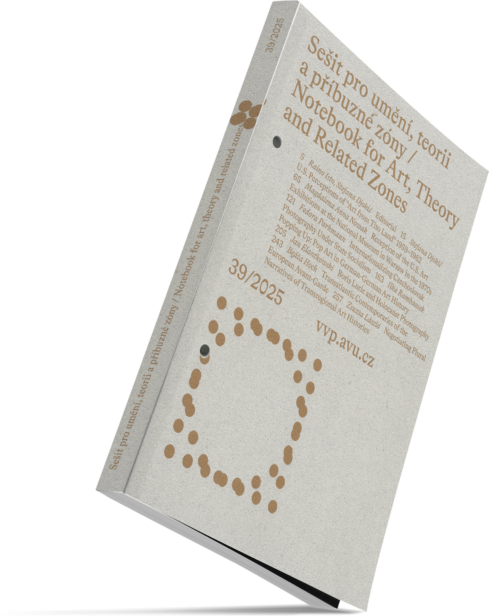
The articles in the 39th issue of Notebook grew out of the seminar series Linking (Art) Worlds: American Art and Eastern Europe from the Cold War to the Present, funded by the Getty Foundation and held between 2022 and 2024 at various locations in East-Central Europe and the United States of America. The contributors seek to move beyond the still predominant approach to the study of Cold War cultural diplomacy, which is characterized by binary thinking and an emphasis on differences rather than by a search for shared features and points of convergence. Stefana Djokić examines the first exhibition of modern Yugoslav art in the United States, held between 1959 and 1962. Through this exhibition, Tito’s regime sought to communicate an image of Yugoslavia as a country that, unlike other socialist states, pursued its own path—manifested in the abandonment of socialist realism and an openness to modernism. Magdalena Anna Nowak analyses the reception of four exhibitions of American art held in Warsaw in the 1970s, demonstrating that Polish criticism maintained a certain degree of independence in its assessments from both U.S. cultural policy and the domestic political regime. Fedora Parkmann takes readers to Czechoslovakia in the years 1958–1968, showing through the example of the book series Umělecká fotografie (Fine-Art Photography) that approaches to photography under the state-socialist regime shared with the West an emphasis on the cultural valorization of the medium, its documentary character, and its humanism. Ilka Rambausek’s article moves symbolically across both sides of the Berlin Wall and investigates the role played by the reception of Pop Art in intra-German cultural exchange. In the final study, Jan Elantkowski focuses on the American artist of Latvian-Jewish origin Boris Lurie and his provocative collages, in which he confronted American consumerism with the repressed memory of the Holocaust. The issue also includes two reviews. In the first, Beáta Hock reflects on the exhibition Modern Times: The American Dream and the Avant-Gardes of the 1920s, held in Dresden in 2025. In the second, Zsuzsa László reviews the book Plural and Multiple Geographies of Modern and Contemporary Art in East-Central Europe (Routledge, 2024), edited by Caterina Preda and Magdalena Radomska.
Content
Stefana Djokić
Diplomacy Through Culture: U.S. Perceptions of "Art from Tito Land" 1959–1962
This article examines the organization of the exhibition New Painting from Yugoslavia (NPE), the first exhibition of modern Yugoslav art in the U.S. from 1959 to 1962. It argues that art played a crucial role in constructing Yugoslavia’s relationship with the West, a relationship that was characterized by distrust, prejudice, and Cold War tensions between the two countries’ opposing ideological systems. Specifically, it will be shown that art was responsible for both bridging and illuminating these differences.
Crucially, the article demonstrates that Yugoslavia was not merely a passive recipient of Western cultural influence during the Cold War, but that it also played an active role in projecting a public image of Yugoslavia in the cultural sphere. Yugoslav government engaged with American curators to construct its national image as distinct from other socialist countries, and to consolidate its independent position between East and West politics. The article is therefore one of the first to explore the cultural dimension of Yugoslav art during the Cold War, which has largely been neglected and still remains insufficiently studied, and to assess the success and limits of Yugoslavia’s “soft power” in the U.S.
Magdalena Anna Nowak
Clashing Ideologies and Shifting Aesthetics: Reception of the U.S. Art Exhibitions at the National Museum in Warsaw in the 1970s
This article examines four leading exhibitions of American art held at the National Museum in Warsaw in the 1970s, which were key components of the U.S. State Department’s cultural diplomacy initiatives directed at the socialist countries of Eastern Europe—specifically the People’s Republic of Poland. During the long 1970s, American art was showcased many as seven major exhibitions, including The American Dream and the bicentennial survey Two Hundred Years of American Painting (1976), which involved the presentation of Willem de Kooning and Robert Rauschenberg. 1970s: New American Painting exhibition was organized more than a year before the imposition of martial law in Poland in 1981, and brought to a close a decade of dynamic U.S.-Polish cultural collaborations.
Drawing upon archival and diplomatic cables between the U.S. Embassy in Warsaw and the U.S. Information Agency—as well as contemporary press reviews, exhibition catalogs, and display photographs, this article reconstructs the cultural narratives propagated by official channels. The analysis of curatorial strategies reveals both the official and unofficial reception of American art, and considers the extent to which cultural journals of the time, Polish critics, and visitors engaged with and interpreted the presented works. The article also provides insightful and critical commentary on U.S. movements such as Pop Art and Abstract Expressionism, often seen as complex, sometimes controversial, but ultimately supportive of informed critique.
Fedora Parkmann
Internationalizing Czechoslovak Photography Under State Socialism: The Book Series Umělecká fotografie, 1958–1968
In 1958, the state publishing house SNKLHU (later Odeon) released a series of small-format monographs on major Czech, Slovak, and foreign photographers, titled Umělecká fotografie. Framed as a form of popular art history, the series was intended to promote photographic art among the general public. This introductory volume also outlines the development of the series, which continued to appear throughout the 1960s and 1970s and explores the editorial strategy behind it, including how it sought to position Czechoslovak photography within an international context. Drawing on a transnational perspective, the series included works by photographers from both Eastern bloc countries—such as Poland and the USSR—and from the West, offering a rare opportunity for artistic exchange across ideological divides. This international outlook extended to commentary formats as well, with texts written by a range of domestic and foreign authors.
The article examines photography as a medium shaped by both ideological constraints and creative ambitions. Instead of presenting a unified vision, the series reveals a complex interplay between official cultural policy and individual artistic expression. The study highlights how photographers navigated the expectations of socialist realism while engaging with modernist trends, often negotiating a balance between conformity and experimentation. In doing so, it contributes to a broader understanding of photography’s role in the cultural landscape of Cold War Europe.
Ilka Rambausek
Popping Up: Pop Art in German-German Art History
A 1984 installation by West German artist Hans Haacke included a symbolic Berlin Wall and a painting quoting a portrait by East German artist Walter Womacka, which in turn mimicked the style of Pop artist Robert Rauschenberg. This complex entanglement of references raises a crucial question: what role did Pop Art play in German-German art history?
Erich Honecker’s call for “broadness and diversity” in 1971 made it possible to introduce new pictorial means into GDR painting, and state-loyal artists used the forms of Pop Art to modernize their styles. But prior to this, East German artists whose works were prohibited had already drawn inspiration from Pop Art to criticize the GDR behind closed doors: they created idiosyncratic styles partly inspired by Pop Art and by the artistic heritage of the Bauhaus and Russian avant-gardes. At the time Pop Art first exhibited in West Germany in the early 1960s, it became a controversial topic in East and West Germany. Back then, it was discussed in the context of an older, politically-influenced German debate about figuration versus abstraction. This article reveals the entanglement of German art discourses on Pop Art, the human figure and the political function of art against the backdrop of an art-historical triangle between the USA and the two Germanys in the postwar era, offering close readings of artworks and individual careers aimed at understanding the relevance of the Western terminology of “Pop” in this context.
Jan Elantkowski
Eastern European Trauma Meets the American Dream: Boris Lurie and Holocaust Photography
Boris Lurie, a Jewish artist originating from Eastern Europe, was one of many who found refuge in the post-World War II United States. Since Lurie’s life was marked with an Eastern European Jewish refugee experience, his artistic activity between the 1950s and 1960s can be acknowledged as an example of transnational trauma. This paper delves into his artistic use of original black-and-white war photographs documenting the Holocaust together with the then contemporary colorful advertisements found in print magazines, as he was strongly influenced by American post-war aesthetics: consumer culture and visual language including advertising, pin-up girls, and even Pop Art influences. Lurie’s works employ a Western artistic vocabulary that, at first glance, might suggest an Eastern European artist captivated by the American Dream. However, this artistic choice reflects his criticism of the abrupt shift from war trauma to consumerism prevalent in post-war Western Europe and the United States. The subject of this paper is the circulation of the images, original photographs of the Holocaust, as used in Lurie’s works. I assert that they represent a highly radical approach to trauma, and an atypical one regarding the first generation of Holocaust survivors, irrespective of their position within the divided Cold War world.
Beáta Hock
Exhibition review: Modern Times. The American Dream and the Avant-Gardes of the 1920s, Przemyslav Strożek, Dresden: Archiv der Avantgarden – Egidio Marzona, 11/04/2025–10/08/2025
Zsuzsa László
New Maps for Old Terms: Negotiating Plural Narratives of Transregional Art Histories
Book review: Caterina Preda – Cristina Bogdan (eds.), Plural and Multiple Geographies: Contemporary Art in East-Central Europe, New York: Routledge 2024, 272 pages.